
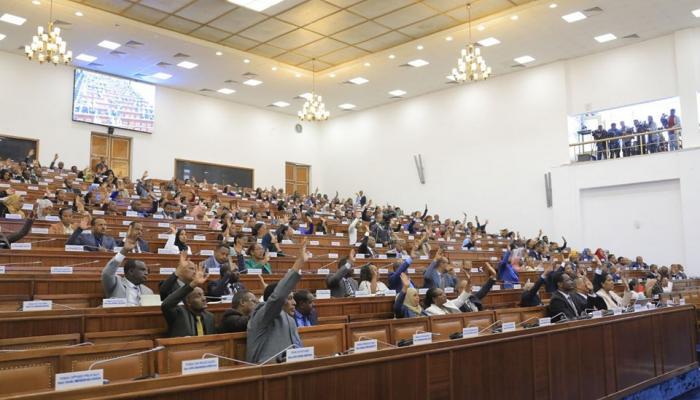
The House of People’s Representatives has approved an additional budget of 582 billion birr for the federal government for the 2017 E.C fiscal year, according to information received from the office of the House of Representatives.
The additional budget was approved during the 6th regular meeting of the House of Representatives held today. The additional funds will be used for various purposes including foreign and domestic debt payment, social budget subsidy (such as fertilizer, medicine, and cooking oil), expansion of capital projects, social safety net programs, and salary reform for government employees.
Minister, Government’s Chief Whip Tesfaye Beljge (Dr.) explained that out of the 582 billion Birr additional budget, 393 billion Birr will be allocated for regular expenditure, 70 billion Birr for capital expenditure, and 119 billion Birr for expenditure adjustment.
Some members of the council raised concerns regarding the additional budget, questioning if it was too much and if it would cause inflation in the market. They also expressed concerns about the pressure the additional taxes could put on taxpayers.
In response, Minister of Finance Mr. Ahmed Shide stated that the proposed additional budget is appropriate for a country with 120 million people and is economically developing. He assured that the additional budget would be financed from domestic and foreign income and would mainly benefit low-paid government employees and safety net users, therefore it would not significantly impact inflation.
After a discussion, the council approved the additional budget bill for the federal government for the 2017 E.C fiscal year by majority vote, with three dissenting votes and five abstentions.
Earlier in June, the council had approved the regular budget for the federal government for the 2017 E.C fiscal year, totaling 971.2 billion Birr. With the addition of the new budget, the federal government’s total budget for 2017 E.C now stands at 1.5 trillion Birr.
The increase in the budget is attributed to the macroeconomic reforms that Ethiopia recently underwent, resulting in an increase in both domestic and foreign budgets.
The regular budget presented in June allocated funds for various purposes including regular expenses, capital expenditures, support for regional governments and sustainable development. A significant portion of the budget was also allocated for debt repayment.
The federal government’s regular budget for the 2017 E.C fiscal year was presented as follows: 451 billion Birr for regular expenses, 283.2 billion Birr for capital expenditures, 222.7 billion Birr for supporting regional governments and sustainable development, with 140 billion Birr allocated for the implementation of various goals.
It was reported that the government had allocated 139.3 billion Birr from the 2017 E.C budget specifically for debt repayment.
The government plans to cover the 2017 E.C budget using domestic revenue sources and foreign aid and loans.
In a recent press briefing, Finance Minister Ahmed Shide stated that the salary adjustments for government employees were necessitated by the macroeconomic reforms, anticipated to impose extra financial burdens on those with fixed and low incomes.
Leave a Reply
You must be logged in to post a comment.