
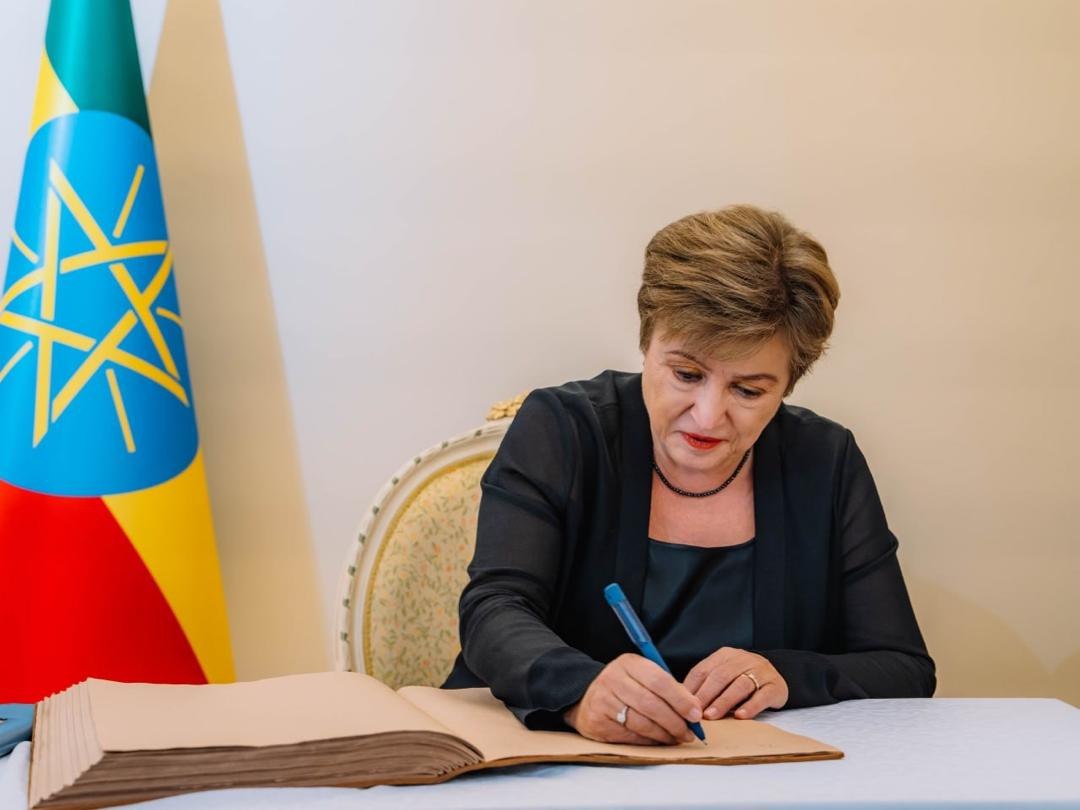
Kristalina Georgieva, the Managing Director of the International Monetary Fund (IMF), announced that Ethiopia’s macroeconomic reform is fraught with challenges, emphasizing that the economic recovery is “challenging” and will take time.
Georgieva visited Ethiopia on February 8 and 9, 2025. During her visit, she met with various senior officials, including Prime Minister Abiy Ahmed (Dr.).
In a joint press conference with Ethiopia’s Minister of Finance, Ahmed Shede, Georgieva expressed gratitude for the warm welcome. She urged the Ethiopian society to “maintain unity” to implement these policies, stressing that the reform will eventually yield “wonderful results.”
Georgieva acknowledged the difficulties of the economic reform program being implemented by Ethiopia, noting that while the reform process is challenging, it will ultimately bring significant benefits. She mentioned that “some of the reform measures are already becoming evident” and emphasized that “society should support the economic reform by uniting.”
Highlighting Ethiopia’s achievements, Georgieva pointed out that the country achieved an economic growth rate of 8.1 percent in 2024, surpassing the IMF’s forecast of 6.1 percent. She stated that the economic program reflects Ethiopia’s commitment to sustained economic growth and stability, positioning it as a role model for other African nations.
Georgieva also mentioned that the reform program aims to improve the standard of living for Ethiopian citizens by enhancing fiscal policy, addressing structural economic issues, and encouraging investment.
Additionally, she noted that the economic reform program designed by Ethiopia will not only transform the country’s economic development but also serve as a guiding framework for other African countries aspiring to achieve economic growth.
Prime Minister Abiy Ahmed (Dr.) conveyed his appreciation for the IMF’s continued technical and financial support in a message on his social media page. He acknowledged the personal efforts and contributions of Georgieva and the IMF, stating that Ethiopia’s Macroeconomic Reform Program, one of the largest support programs funded by the IMF, has significantly shaped the nation’s growth and development dreams based on an indigenous vision and change agenda.
However, despite these expressions of optimism, the people of Ethiopia, particularly low-income earners and civil servants, are facing significant hardships due to the economic reform. The reform has increased the cost of living and exacerbated existing problems, which stem from ongoing civil wars, including the Tigray genocidal war. These issues include high unemployment rates, migration, and high poverty rates. Consequently, this economic reform has worsened the challenges faced by the people.
Leave a Reply
You must be logged in to post a comment.