
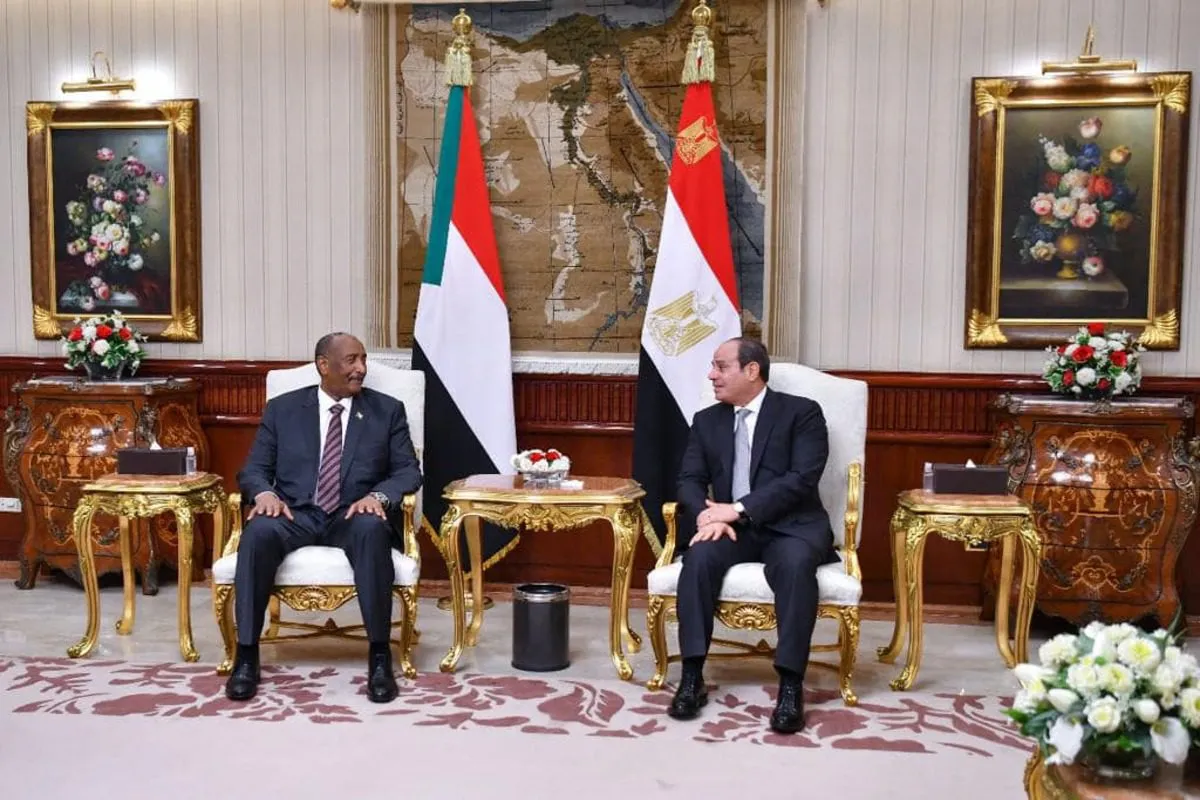
The State Information Center of Egypt has reported that Egyptian President Abdel Fattah al-Sisi and the Chairman of the Sudanese Sovereignty Council, General Abdel Fattah al-Burhan, held discussions on joint efforts to protect water security in the Nile Basin.
The Chairman of the Sudanese Sovereignty Council, General Abdel Fattah al-Burhan, visited Cairo on April 28, 2025. During his meeting with Egyptian President Abdel Fattah al-Sisi, the two leaders discussed a range of regional issues, with a particular focus on the Horn of Africa and the Blue Nile Basin, according to a statement from the Egyptian presidency. They also addressed Sudan’s reconstruction efforts and the security of Blue Nile River water resources.
Egyptian presidential spokesman Ambassador Mohamed El-Shenawy stated that the two countries addressed “water security,” emphasizing their opposition to any unilateral action on the Blue Nile. He added that the leaders affirmed their commitment to upholding international law in a way that benefits all nations within the Nile Basin.
“A convergence of perspectives between the two countries was underpinned by the close connection between the national security of both Egypt and Sudan” the presidency noted, adding that the two sides explored collaborative efforts to safeguard water security in the region.
Egypt has consistently maintained that Ethiopia should not proceed with the filling of the Grand Ethiopian Renaissance Dam (GERD) without a legally binding tripartite agreement governing the volume of water released from the reservoir.
Ethiopia has consistently maintained that a formal agreement on water release from the Grand Ethiopian Renaissance Dam (GERD) could be reached if Egypt, Sudan, and Ethiopia agree on their respective shares of the Nile River. However, previous negotiations—led by the African Union, the United States, and the World Bank over the past years—failed to produce a consensus on the matter.
While the Grand Ethiopian Renaissance Dam, slated for completion this year, has already begun generating electricity, Egypt continues to voice concerns that the project could significantly reduce its share of Nile River water. Egypt has long protested against the dam and has recently stepped up regional coordination, contrasting Ethiopia’s push for a Red Sea access strategy.
Last week, Egypt and Djibouti affirmed that the administration and security of the Red Sea and the Gulf of Aden fall solely under the authority of the coastal nations bordering these waterways. Egypt also reiterated this stance during Somali Foreign Minister Ahmed Moallem Fiki’s visit to Cairo in December.
Additionally, Presidents al-Sisi and al-Burhan met at the Egyptian presidential palace, where they discussed ways to strengthen bilateral ties. Egypt also expressed its willingness to contribute to Sudan’s reconstruction efforts.
The discussions between the two leaders centered on developments following the Sudanese military’s recapture of Khartoum, as well as broader regional concerns regarding the Nile River Basin and the Horn of Africa.
During the talks, both sides agreed to continue efforts to provide necessary support and humanitarian assistance to Sudanese citizens living in conflict-affected areas.
Leave a Reply
You must be logged in to post a comment.