
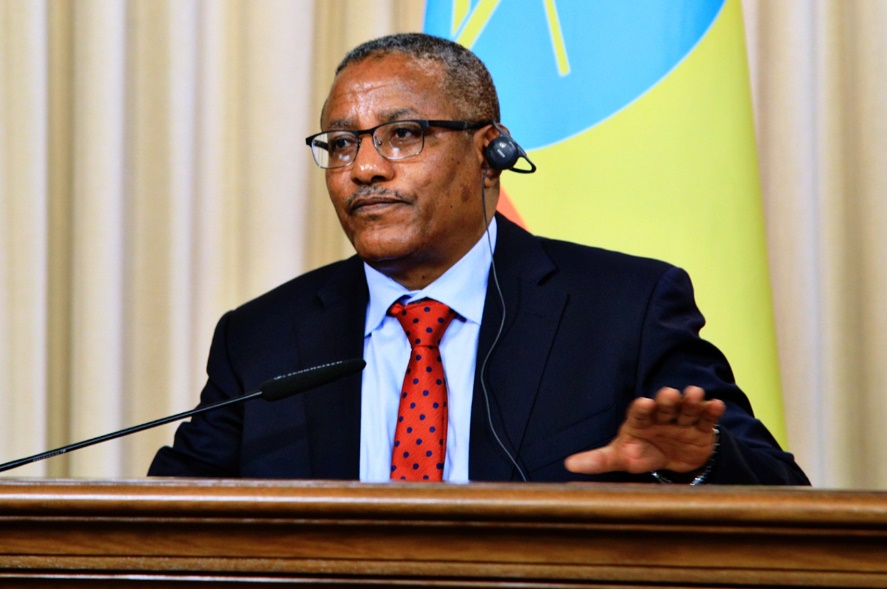
Gedu Andargachew has rejected Prime Minister Abiy Ahmed’s assertion that he delivered a message to Eritrean authorities calling for an end to atrocities committed against the Tigrayan people during the Tigray war.
Former Foreign Minister Gedu Andargachew has rejected Prime Minister Abiy Ahmed’s parliamentary assertion that he was sent to Asmara with a message demanding an end to Eritrean army atrocities during the Tigray War.
In a letter dated Wednesday, 4 February 2026, Gedu acknowledged that he traveled to Eritrea but said the message he carried from the prime minister was to “take joint precautions” against what he described as a “smear campaign related to human rights violations.” He added that, during the conflict, Eritrean forces “worked together” with the Ethiopian National Defense Forces “as if they were one country” and advanced “as far as Debre Tabor” in operations against Tigrayan forces.
Context and parliamentary remarks
Prime Minister Abiy raised the Ethiopia–Eritrea relationship in a speech to the House of Peoples’ Representatives, saying the conflict between the two countries “began” during the Tigray War. He accused Eritrean soldiers, who fought alongside government forces, of committing mass killings in Axum and of destroying factories and shops in Shire, Adwa and Adigrat. Abiy said he had sent “several envoys to Eritrea” after those attacks, and named Gedu as one of those envoys.
Abiy told parliament: “Honorable Ato Gedu was the Minister of Foreign Affairs at the time. I sent him to Eritrea twice. What he sent was, ‘Don’t abuse my Tigray people, don’t plunder their wealth; the conflict is with the TPLF, not with the Tigray people.’” He added that Gedu “may also testify.”
Gedu’s response and timeline
Gedu, now an opponent of Abiy’s government, responded in writing that Abiy had “considered him as a witness” in the parliamentary address but disputed the prime minister’s account. He noted that although he was appointed Minister of Foreign Affairs in April 2019 and served in that role until the outbreak of the Tigray War, he was reassigned on 4 November 2020—one day after the war began—as National Security Advisor to the Prime Minister.
In his letter, Gedu confirmed a January 2021 trip to Asmara with “a Foreign Ministry official” to deliver a message to Eritrean President Isaias Afwerki, but he said the content differed from Abiy’s description. “The prime minister has made a big mistake in this regard,” Gedu wrote.
Gedu said the message he delivered focused on three points. The first conveyed congratulations to President Isaias “on our victory in the joint operation against the Woyane.” The second expressed gratitude to the Eritrean government and people for the care given to their forces during the Northern Command’s attack and for the “brotherly support” in preparing a counterattack. The third addressed what Gedu described as a “widespread smear campaign” alleging human rights violations, which he said was being driven by “some Woyane (TPLF) supporters and foreign forces” seeking to undermine Ethiopia–Eritrea relations through international organizations and media.
Gedu said the core warning he carried was: “We need to be careful because this could end up harming both of us.”
On troop withdrawal and Tigray suffering
Gedu said he raised the question of asking Eritrea to withdraw its troops, but that Abiy “warned me not to ask Eritrea to withdraw its troops at all.” He said he accepted the mission as instructed and delivered the message as received.
He denied that he was given any directive specifically concerning the people of Tigray. “Your concern at the time was the potential for a human rights violation case against us, but the suffering of the people of Tigray was never on your agenda,” he wrote, directly challenging the prime minister’s parliamentary remarks.
Gedu said President Isaias responded in Asmara that he would instruct subordinate structures “to be as careful as possible,” and that he and Abiy agreed there remained “a lot of work to do.” Gedu said he relayed that response back to the prime minister.
Eritrean involvement and joint operations
In his letter, Gedu acknowledged Eritrean participation in the Tigray War. “I don’t think there was a time when the Eritrean army did not stand by the Ethiopian National defense forces from the beginning of the Tigray War until the Pretoria Agreement,” he wrote. He added that in the summer of 2023, when Tigrayan forces crossed into the Amhara region, Eritrean troops had reached “as far as the Debre Tabor area.”
Gedu said joint military operations between the Ethiopian National Defense Forces and the Eritrean Army ceased only after the Pretoria Agreement was signed. “Until then, they were together as if they were the army of one country,” he concluded.
Leave a Reply
You must be logged in to post a comment.