
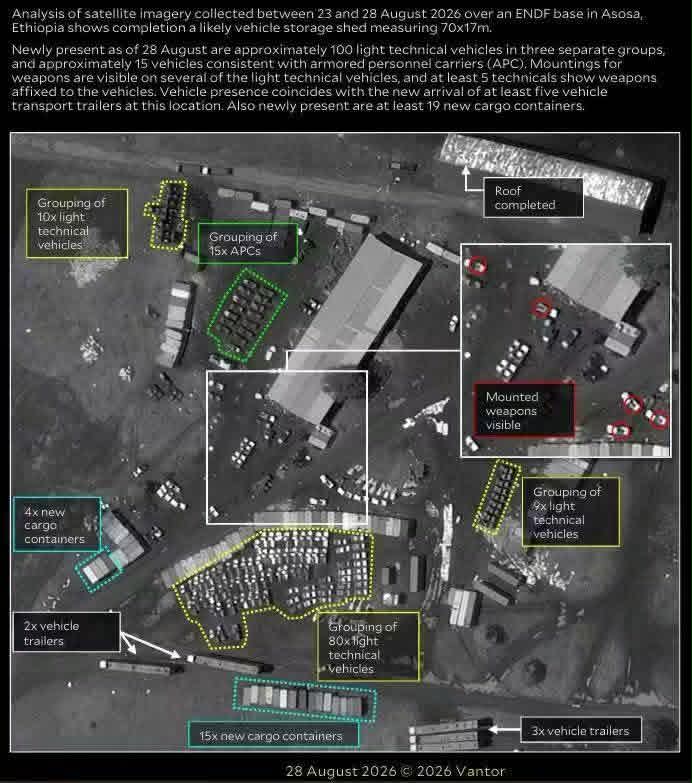
Satellite imagery points to a rapid buildup of military equipment and logistical capacity at an Ethiopian base near Sudan, raising concerns over a possible new RSF offensive toward Blue Nile State.
A significant military buildup has been detected at an Ethiopian military facility near the Sudanese border, according to satellite analysis by the Humanitarian Research Lab (HRL) at Yale School of Public Health. The developments are raising concerns about the possibility of a major new operation by the Rapid Support Forces (RSF) in Sudan’s Blue Nile region.
Yale’s Humanitarian Research Lab has previously documented evidence of military assistance to RSF forces at the Ethiopian National Defense Force (ENDF) base in Asosa. In April 2026, the lab published a special report titled Evidence of Military Assistance to RSF at ENDF Base in Asosa, Ethiopia. A subsequent June report documented continued support to RSF forces at the same location.
Rapid increase in military equipment
The latest satellite observations reportedly indicate an extraordinary increase in military equipment and logistical activity at the Asosa facility.
According to the analysis, the amount of visible military equipment has increased approximately sixfold, with more than 100 militarily equipped 4×4 vehicles and armored personnel carriers arriving within a matter of days.
The scale and speed of the buildup are particularly significant because they suggest that the facility may have acquired the logistical capacity necessary to assemble, transport, and support a substantial fighting force.
Yale’s analysis estimates that the available logistical infrastructure could support the movement and maneuver of approximately 750 to 1,000 fighters, a force roughly equivalent to a brigade.
Trucks and containers signal logistical preparations
Satellite imagery also reportedly shows numerous military transport trucks and containers positioned for movement. Several trucks and containers have been observed near the eastern exit of the facility, suggesting that equipment may be prepared for onward transportation.
The satellite analysis identified an increase of at least 60 shipping containers at the ENDF facility between June 29 and August 23, 2026.
Activity continued during the final week of August. Between August 23 and August 28, at least 15 additional shipping containers and eight cargo transport trucks were reportedly observed at the site.
The construction of new infrastructure also appears to have accelerated. Yale’s analysis identified the completion, by August 23, of a facility measuring approximately 70 metres by 17 metres, believed to be a vehicle-storage hangar. Construction of the structure had been observed during the preceding weeks.
Possible implications for Blue Nile
The buildup is particularly significant because of the facility’s proximity to Sudan’s Blue Nile State.
The available satellite evidence does not, by itself, establish that an attack on Ed Damazin is imminent. However, the scale of the military and logistical preparations has raised concerns that the buildup could support a major RSF operation directed toward the Blue Nile region.
Ed Damazin, the capital of Blue Nile State, is strategically important to the Sudanese Armed Forces (SAF). An offensive in the region could potentially force the SAF to divert troops and resources away from other active fronts.
One possible strategic objective could therefore be to create pressure in Blue Nile while simultaneously relieving pressure on RSF positions and operations in North Kordofan, including the El Obeid front.
A potentially wider regional escalation
The reported developments also raise broader questions about Ethiopia’s role in the Sudan conflict.
The Asosa facility is located inside Ethiopia and is associated with the ENDF. Yale’s previous reporting has already identified evidence consistent with military assistance to RSF forces at the site.
If the latest buildup is indeed connected to RSF operations, the movement of a brigade-sized force from or through the area could represent a significant escalation in the regional dimension of Sudan’s war.
It could also increase tensions between Sudan and Ethiopia and potentially draw greater attention from regional and international actors concerned about the expansion of the conflict beyond Sudan’s borders.
What the satellite evidence tells us—and what it does not
Satellite imagery provides an important window into military activity in areas where independent access is extremely limited. Yale’s Humanitarian Research Lab specializes in analyzing and preserving open-source and remote-sensing information, including satellite imagery, for humanitarian and accountability purposes.
The imagery can document the movement, concentration, construction, and logistical preparation of military assets. It cannot, however, independently establish the precise intentions of the forces observed.
Consequently, the reported buildup should be understood as a serious warning indicator rather than definitive proof that an attack on Ed Damazin has been ordered or is about to begin.
Nevertheless, the combination of a rapid increase in military vehicles, armored equipment, transport capacity, shipping containers, and new storage infrastructure represents a development that warrants close monitoring.
If the assessment that a brigade-sized force is being assembled for RSF operations is confirmed, the consequences could extend well beyond the Blue Nile battlefield, potentially altering the balance of forces across several Sudanese fronts.
The critical question
The central question now is not simply whether military equipment has accumulated at the Asosa facility. The more important question is where that force and equipment will ultimately be deployed.
If the buildup is connected to a planned RSF operation in Blue Nile State, Ed Damazin could become a new major flashpoint in Sudan’s war. If the force is instead intended to reinforce another front, the buildup could still signal a significant expansion of RSF military capabilities.
For now, the satellite evidence points to an unmistakable increase in military and logistical activity. What remains uncertain is the final destination, operational objective, and timing of any potential deployment.
Given the strategic importance of Blue Nile State and the continuing fighting across Sudan, developments around the Asosa facility will warrant particularly close scrutiny in the days ahead.


Leave a Reply
You must be logged in to post a comment.