
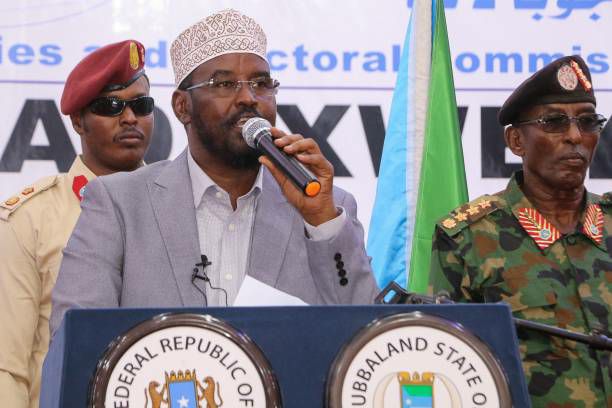
The semi-autonomous Jubaland region, embroiled in a dispute with the federal government of Somalia, has announced the severance of its relationship and cooperation with the federal government. President Ahmed Mohammed Islam, also known as Madobe, has led Jubaland since 2013 and accused the Somali government of violating the constitution and undermining the unity of the people.
Jubaland, which borders Kenya and Ethiopia, is one of Somalia’s five semi-autonomous regions, and President Madobe has been elected for a third term in recent elections.
The President of Somalia, Hassan Sheikh Mahmoud, based in Mogadishu, rejected the election, claiming it was conducted without the participation of the federal government. Subsequently, the federal government issued an arrest warrant for Madobe, and Jubaland reciprocated with an arrest warrant for President Hassan Sheikh Mohamud.
In response, President Madobe announced the severance of any relationship with the federal government.
“The government of Jubaland has officially cut off all ties and cooperation with the Federal Government of Somalia,” the Jubaland government stated on November 27, 2024. President Madobe’s administration has accused Somali President Hassan Sheikh Mahmoud of constitutional violations, abuse of power, and corruption.
Allegations include stoking “civil wars and ethnic conflicts,” creating insecurity in Jubaland, and compromising efforts to fight insurgency. President Madobe’s administration emphasized that the peace achieved by Jubaland soldiers after decades of conflict is being disrupted by the actions of the federal government of Somalia.
Jubaland has expressed criticism towards the constitutional and administrative reforms undertaken by the federal government of Somalia, arguing that they pose a threat to Jubaland’s autonomy and the federal structure. Meanwhile, Puntland, another semi-autonomous state, announced several months prior that it would not acknowledge the constitutional amendments made by Somalia and would consequently withdraw from the federal system.
Constitutional amendments aimed to end clan-based indirect voting and promote the right to vote for all citizens. Former Somali presidents and politicians, including Puntland State, opposed the reform, citing lack of public involvement. The Jubaland government stated it does not accept the constitutional amendments by federal government councils and electoral laws.
The Jubaland government plans to establish a consultation forum involving all political stakeholders to advise on future administrative issues, national unity, and the solidarity of the Somali people.
Conversely, on Wednesday, November 26, 2024, the Mogadishu court issued an arrest warrant for Madobe, citing treason and the disclosure of confidential information to foreign entities. The federal government has challenged the enforceability of the court’s arrest mandate, noting that both President Hassan Sheikh Mohamud and Madobe command their own military forces.
Somalia’s Information Minister, Daoud Awais, told to Reuters that the judiciary, which holds the authority to enforce the law, is responsible for the arrest warrant. Meanwhile, the Jubaland government has not issued a statement regarding the severance of its ties with the federal government.
Leave a Reply
You must be logged in to post a comment.