
The Ethiopian Government Emphasizes Ethiopia’s Right to Access the Sea.
The federal government has reaffirmed Ethiopia’s ‘right to access the sea’ and emphasized that the country’s diplomatic efforts to secure access to the sea must move forward with the established clarity and legal direction. Additionally, the government has called on the international community to acknowledge Ethiopia’s vital role in advancing peace and security throughout the region.
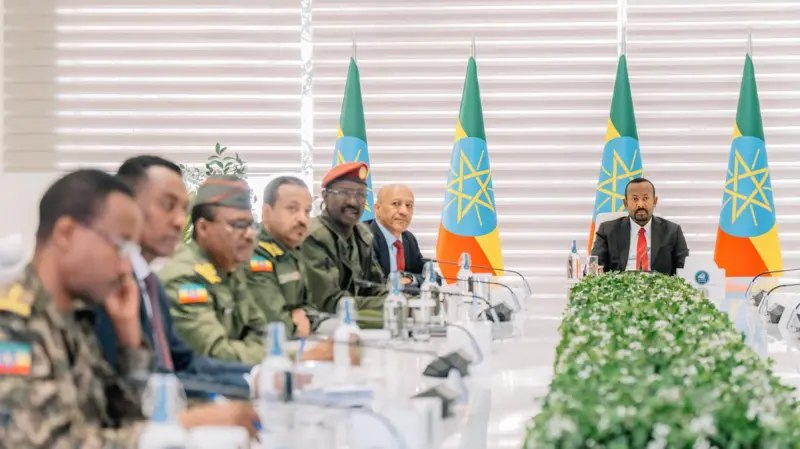
This announcement was made in a statement issued by the Prime Minister’s Office following a meeting of the National Security Council held today, Wednesday, April 9, 2025. The meeting, chaired by Prime Minister Abiy Ahmed and attended by senior government officials, including Field Marshal Brhanu Jula, Chief of the Ethiopian National Defense Force (ENDF), was focused on assessing “national, regional, and global situations.”
Key Issues Highlighted by the Council
The statement highlighted several critical issues identified by the Council as requiring immediate attention. Among them were threats posed by groups engaged in “forcefully enforcing demands” through unethical and violent means. These entities were described as employing tactics such as conspiracy, entrapment, robbery, coercion, cruelty, illegal trade, and aggressive enforcement.
Furthermore, the Council accused these groups of collaborating with Ethiopia’s adversaries both domestically and internationally, fostering false propaganda, and exacerbating instability.
Another key focus of the meeting was the examination of “global and regional conditions” and their potential impact on Ethiopia. Detailed discussions covered topics such as the global economic climate, escalating tensions, terrorism, disrupted international trade routes, the weakening and collapse of certain nations, increasing cyberattacks, and shifting global alliances. However, the statement did not specify which countries were deemed to be “collapsing and weakening.”
Directions and Resolutions
In response to these challenges, the Council outlined strategies addressing various pressing issues. Regarding armed groups, the Council acknowledged the progress made through political dialogue to resolve conflicts and emphasized the importance of using peaceful methods, including traditional approaches, to make these efforts more effective.
Nevertheless, the statement stressed the necessity of reinforcing law enforcement against groups that reject peace and resort to violence to achieve their goals. It declared that individuals accepting assignments from Ethiopia’s adversaries and attempting to disrupt national stability would face decisive law enforcement measures until their activities are completely neutralized.
The Council also lauded Ethiopia’s increasing diplomatic achievements, which have elevated the country’s global visibility. It advocated for the continuation and expansion of efforts to protect Ethiopia’s national interests at the international level.
Leave a Reply
You must be logged in to post a comment.