
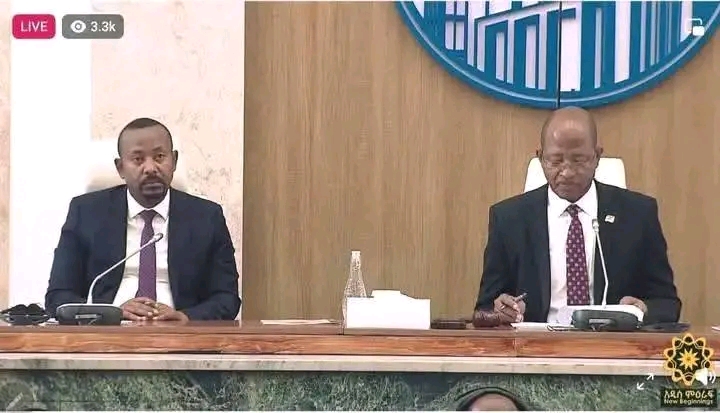
Ethiopia–Eritrea Ties Soured After Axum Killings and Factory Looting, PM Abiy Tells Parliament
Prime Minister Abiy Ahmed told Ethiopia’s House of People’s Representatives that the deterioration of relations between Ethiopia and Eritrea began with the outbreak of the two‑year devastating war in the Tigray region, not with Ethiopia’s recent push for Red Sea access.
Speaking before parliament, Abiy rejected claims that Ethiopia’s maritime ambitions triggered the current standoff with Eritrea. “Some people say, they think, they analyze that the problem between the Ethiopian and Eritrean governments arose because the Ethiopian government raised the issue of the Red Sea. But that is not the case,” he said, stressing that tensions had already emerged at the start of the Tigray war.
According to the Prime Minister, the first clash occurred after federal forces captured Shire during the initial phase of the war. “After we entered Shire, the Eritrean army followed us into the city and began destroying individuals houses and buildings. Although we did not speak publicly at the time, that is when the conflict began,” Abiy explained.
He went on to describe how the situation worsened as fighting spread to historic towns in central Tigray. “It was a bloody battle when Eritrean forces entered Axum and committed mass killings of young people,” Abiy told to the members of the Parliament. In Adwa, Eritrean troops destroyed and looted factories, while in Adigrat they looted equipment from a pharmaceutical plant and destroyed what remained. Abiy said these actions were a major factor in the breakdown of ties.
The Prime Minister acknowledged that his government was unable to confront Eritrea directly at the time, as Ethiopian forces were stretched across multiple fronts. “The Ethiopian government did not have the capacity to fight on multiple fronts,” he said, noting that the priority then was tracking TPLF fighters and consolidating captured positions.
Abiy emphasized that his remarks were not a shift in policy but a recounting of historical events. He said he had repeatedly attempted to stop the atrocities through diplomacy. “I sent several envoys to Eritrea when young people were killed in Axum, and when Adwa and Adigrat were looted,” he said. The envoys carried the message: “Do not terrorize the people of Tigray, do not plunder their resources; the fight is with the TPLF, not the people of Tigray.”
When those efforts failed, Abiy dispatched then‑Deputy Prime Minister Demeke Mekonnen. Although both officials have since resigned, Abiy stressed that “they are still alive; they can be found, they can tell the truth about why they were sent.”
Meanwhile, at the outset of the war, Prime Minister Abiy Ahmed expressed his gratitude to the Eritrean people and government during an address to the House of People’s Representatives, emphasizing that the war would have been far more difficult without Eritrean support. He later maintained, in discussions with foreign leaders and international institutions, that the Eritrean army had not entered Tigray—despite widespread reports of human rights violations committed by the Eritrean forces and Ethiopian National Defense Forces under his command
Leave a Reply
You must be logged in to post a comment.