
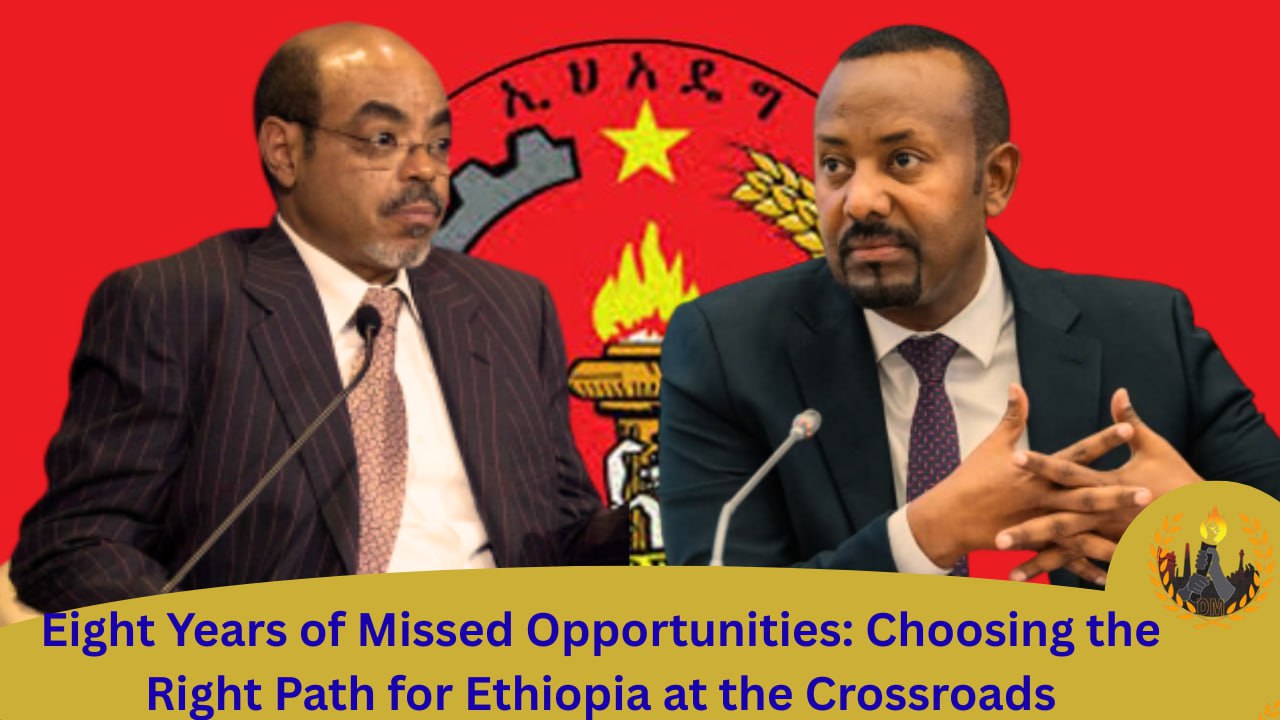
Eight Years of Missed Opportunities: Choosing the Right Path for Ethiopia at the Crossroads
By Justice for the voiceless
For nearly three decades under the leadership of the EPRDF, Ethiopia experienced one of the most significant transformations in its modern history. Despite shortcomings, governance limitations, and corruption among some officials, the country underwent measurable structural change.
The Achievements That Cannot Be Erased
During the EPRDF era, Ethiopia changed dramatically:
• Public universities expanded from a number that could be counted on one’s fingers in a few major regional states to more than three dozen universities spread across all regional states nationwide.
• Thousands of primary and secondary schools were built across rural and urban areas.
• Rural communities gained access to education at unprecedented levels.
• Farmers’ lives improved through agricultural extension programs, improved seeds, irrigation projects, and rural road expansion.
• Food security improved significantly compared to the recurring famine cycles of earlier decades.
• Rural infrastructure expanded including feeder roads connecting villages to markets.
• Clean water access improved through well-drilling projects and rural water systems.
• Small- and large-scale irrigation projects supported agricultural productivity.
• Electricity access expanded dramatically into rural towns and villages.
• Cell phone and telecommunications coverage expanded across much of the country.
• Healthcare facilities were built even in remote districts.
• Child mortality declined.
• Massive infrastructure projects reshaped the country highways, railway stations, industrial parks, and logistics corridors.
• Large hydroelectric dams were built, and additional energy projects were in planning stages.
• Construction was booming across the country housing, commercial buildings, roads, and factories.
• Manufacturing zones and factories were built, while others were in development plans.
• Ethiopia achieved lower-middle-income status in 2015.
• The middle class expanded in major cities.
• Private businesses flourished.
• Many entrepreneurs became multi-millionaires.
• Job opportunities expanded significantly, even though they were not sufficient to absorb the rapidly growing youth population.
• Citizens were able to travel, trade, and work across much of the country 24 hours a day without widespread security threats.
• The Ethiopian National Defense Force gained international recognition for its role in United Nations peacekeeping missions across Africa and beyond, earning a reputation as one of Africa’s leading peacekeeping forces.
Millions of Ethiopians in rural areas saw tangible improvements in access to schools, clean water, electricity, telecommunications, healthcare, food security, and income-generating opportunities.
However, rapid population growth and a youth demographic boom meant that job creation, despite expansion, could not fully satisfy demand. Large numbers of young Ethiopians remained unemployed or underemployed, creating frustration that later contributed to political unrest.
These achievements were real. They transformed the country.
But development without sufficient political reform and inclusive governance created vulnerabilities.
Since 2018: A Nation in Deep Crisis
Following the political transition in 2018 and the dissolution of EPRDF, Ethiopia entered one of the deadliest and most unstable periods in its modern history:
• The war in Tigray resulted in catastrophic human loss, with estimates of hundreds of thousands of deaths.
• Conflict spread across Tigray, Amhara, and Oromia.
• Millions were internally displaced.
• Women, children, and the elderly became war victims.
• Towns were destroyed.
• Humanitarian crises deepened.
The economic consequences have been severe:
• Foreign direct investment declined sharply during instability.
• Inflation surged.
• Businesses suffered.
• Youth unemployment worsened.
• Investor confidence weakened.
• Debt pressures intensified.
• Hard-won poverty reduction gains are at risk of reversal.
Instead of building upon decades of development, the country now faces the danger of systemic collapse.
Fighting Horizontally While the Nation Burns
Ethiopians are fighting each other over:
• Contested territories.
• Political grievances.
• Ethnic divisions.
• Power struggles.
Horizontal conflict is destroying the social fabric.
When citizens fight citizens, everyone loses. While elites negotiate power, ordinary families suffer.
A Direct Message to Government Officials
To those in power:
Stop the war rhetoric.
Stop military preparation against your own citizens and neighboring states.
History shows that governments facing economic crisis, political instability, and internal war cannot secure long-term survival through force alone.
Examples in the region and beyond include:
• The military regime of Derg.
• The government of Siad Barre.
• The rule of Muammar Gaddafi.
• The regime of Saddam Hussein.
• The leadership of Bashar al-Assad, where prolonged war devastated the country.
Once legitimacy collapses, force cannot restore it permanently.
Do not wait until institutions fail and the nation fragments.
You have two paths:
Escalation and eventual collapse or courage, reform, and reconciliation.
History honors those who choose peace at the critical hour.
A Call to the Ethiopian People
This is the 11th hour.
Stand for peace.
Stop celebrating war.
Stop mobilizing youth for destruction.
Say no to dictatorship.
Say no to endless militarization.
Say no to hatred disguised as patriotism.
Peace is not weakness.
Peace is survival.
A Call to the Ethiopian Diaspora
To Ethiopians abroad:
Do not amplify war from a distance.
Support peace, dialogue, and humanitarian recovery.
Your voice can either inflame conflict or promote reconciliation.
Choose wisely.
A Message to Neighboring Countries
Support stability, not escalation.
A crisis in a country of over 120 million people will not remain contained. Refugee flows, economic shocks, and insecurity will affect the entire region.
Regional peace requires political solutions.
A Call to the International Community and the Western World
To global powers and democratic nations:
Use diplomatic leverage to encourage peaceful resolution and de-escalation.
Encourage inclusive dialogue.
Support ceasefire mechanisms.
Condition assistance on civilian protection.
Discourage further war.
Preventing state collapse in the Horn of Africa is both a moral obligation and a global security interest.
Final Appeal
This is not about one party.
Not about one region.
Not about one ideology.
It is about preventing:
• State collapse.
• Generational trauma.
• Permanent economic destruction.
• The suffering of millions of innocent civilians.
Every peace-loving Ethiopian and every responsible international partner has a moral obligation to act now.
History will judge this generation not by how fiercely it fought, but by whether it had the courage to stop the fall before it was too late.
This is the 11th-hour call to save innocent lives and to save Ethiopia itself.
Leave a Reply
You must be logged in to post a comment.